
A business that sells to educational institutions does not run like one that sells to factories. Work arrives as projects. Each project carries its own specification document, its own deadline, and ends in a handover that has to be accepted against stated conditions.
This article introduces one customer that works that way, The Mars Nexus Co., Ltd., the company behind the Thai PLC Center brand, and describes how DigitechX is building its back office. It is written while the work is still underway, so no results are claimed anywhere in it.
What The Mars Nexus does
The Mars Nexus Co., Ltd. is based in Pathum Thani province. It manufactures and distributes Industry 4.0 industrial automation training kits, covering PLCs, which are the controllers that run machines, HMIs, which are the operator panels on the machine itself, IoT devices, and robotic systems.
Beyond the kits, the company runs training courses arranged in eight progressive steps, from basic electrical work through to SCADA systems, which supervise and control a production process, and offers material handling work station kits that include a robotic arm.
The company states that it holds ISO 9001:2015 certification and has memoranda of understanding with vocational colleges across Thailand.
What DigitechX does
DigitechX is a digital technology company for industry. Its services run from IoT systems and the collection and analysis of shop floor data, through enterprise resource planning, specialised software, and digital transformation consulting.
The position stated in the company's own profile document is that it is not solely an Odoo implementer or an IoT vendor, but an end-to-end solution provider, from shop floor data through to management with an ERP.
Why departments need connected records
When a business takes work in as projects, the recurring problem is not a lack of sales. It is that information about one project ends up in several separate places.
Sales keeps project details in its own files. Purchasing raises orders somewhere else. The warehouse records goods in and out on another list. Accounting waits for paperwork from everyone before it can close anything. So when a customer asks how their project is going, answering means asking several people.
Bringing this work onto one database does not automatically reduce the workload. What it does is make every team refer to the same figures, and let questions be answered from the system rather than from each other.
The scope of the current work
The Business Operating System proposal was approved in February 2026. The scope covers customer relationship management, sales, inventory, purchasing, and accounting, all on one database.
Work completed so far includes base system configuration, importing master data, building document templates for quotations, purchase orders and invoices, setting up the chart of accounts and journals, and the parts developed specifically for this engagement.
Five phases, in order
DigitechX starts each project by reviewing how the customer works, then assesses what the standard system covers and what needs custom development.
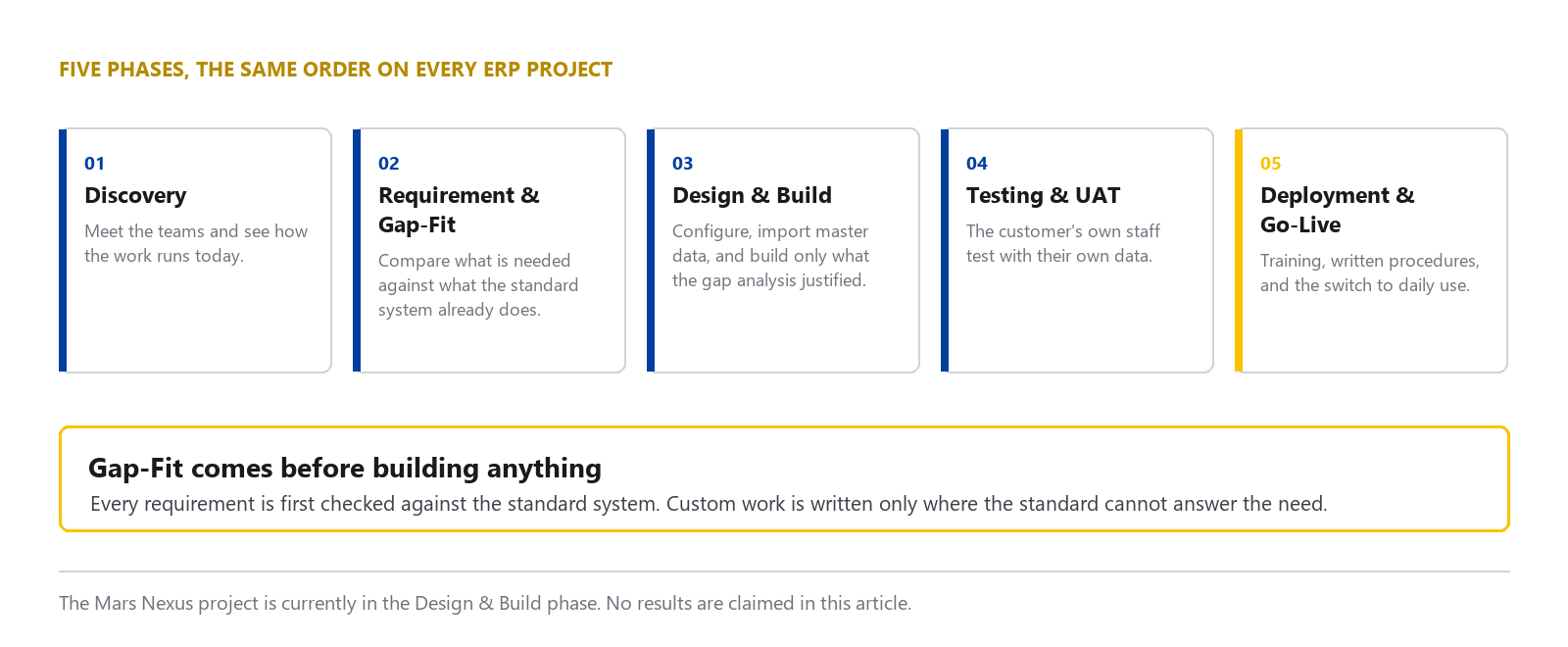
The phase most often skipped on ordinary projects is the second one, comparing the requirement against what the standard system already does. Skip it and the result is custom work commissioned for something the standard system could already handle, which costs time now and becomes a burden at the next upgrade.
We described the same approach for an industrial waste management business in the article on implementing an ERP for a waste management company
Project progress
At the time of writing, the project is in the design and build phase. It has not reached go-live. There are therefore no result figures to report, and we do not yet know what real daily use will show up as needing further adjustment.
Once the system is live and has been in real use for a period, we will come back and write an honest summary of what actually changed.
Contact DigitechX about system implementation
DigitechX builds Business OS and ERP back-office systems. If your business runs on projects, tell us which details you need to track for each one. We can discuss the steps your system needs to support.