
A single supervisor looks after several dozen workstations in one shift. Walking every one of them continuously is not possible. The problem that follows is not that people are careless. It is that a small error happens at the moment nobody is watching, and then surfaces downstream as stock that does not match the system, or as a customer complaint several days later.
This article explains where AI video analytics, meaning a computer analysing camera footage continuously, can help, how it works, and what limits you need to know about before deciding.
The problem is not failing to see, it is failing to keep up
Almost every factory already has closed circuit cameras. What is missing is not the footage but someone free enough to watch all of it. So camera footage ends up used only as evidence after the fact, never for prevention.
What changes when AI analyses the footage is that the system watches every frame of every camera continuously without tiring, and it does not watch for anything unusual in a general sense. It watches against the standard operating procedure for that particular station, checking whether the operator completed every step, in the right order, and whether any step was skipped.
Why this is genuinely achievable today
A few years ago this was research work. You needed a team to develop the models, a large volume of sample footage to train them, and data-centre-class computing. The cost and the timescale meant most factories looked at it and dropped the idea.
What changed is that all the components became things you can simply buy and install. High resolution cameras take power over a single network cable. A processing unit with a graphics card is the size of a desktop computer and can sit inside the factory. And the models for detecting people, objects, and postures are available ready to use, without starting the training from nothing.
The remaining work therefore changed in nature. Instead of developing artificial intelligence from scratch, it became a matter of configuring the conditions to match that station's actual procedure and positioning the cameras to see what has to be checked, which is engineering work with an estimable cost and duration. The consequence is that a trial is measured in weeks rather than years, and uses temporary mounting that comes off when the trial ends.
But the technology being ready does not mean it works the moment it is installed. Site conditions still decide the outcome, which is why the next section covers both what the system can check and what has to be accepted before starting.
What the system can check
For checking standard operating procedure compliance at assembly and packing stations, the capabilities that work in practice are these.
| What is checked | The question it answers |
|---|---|
| Identity confirmation by face | Is the person taking the station trained and authorised for this position |
| Work step sequence | Were all steps completed, was any step skipped or performed out of order |
| Picking and placing the part | Was the scanned item actually placed in the packaging, and was it removed afterwards |
| Reading the station result screen | Was an item the system marked as failed nonetheless packed |
| Packaging completeness | Was the box or carton closed before the count was complete |
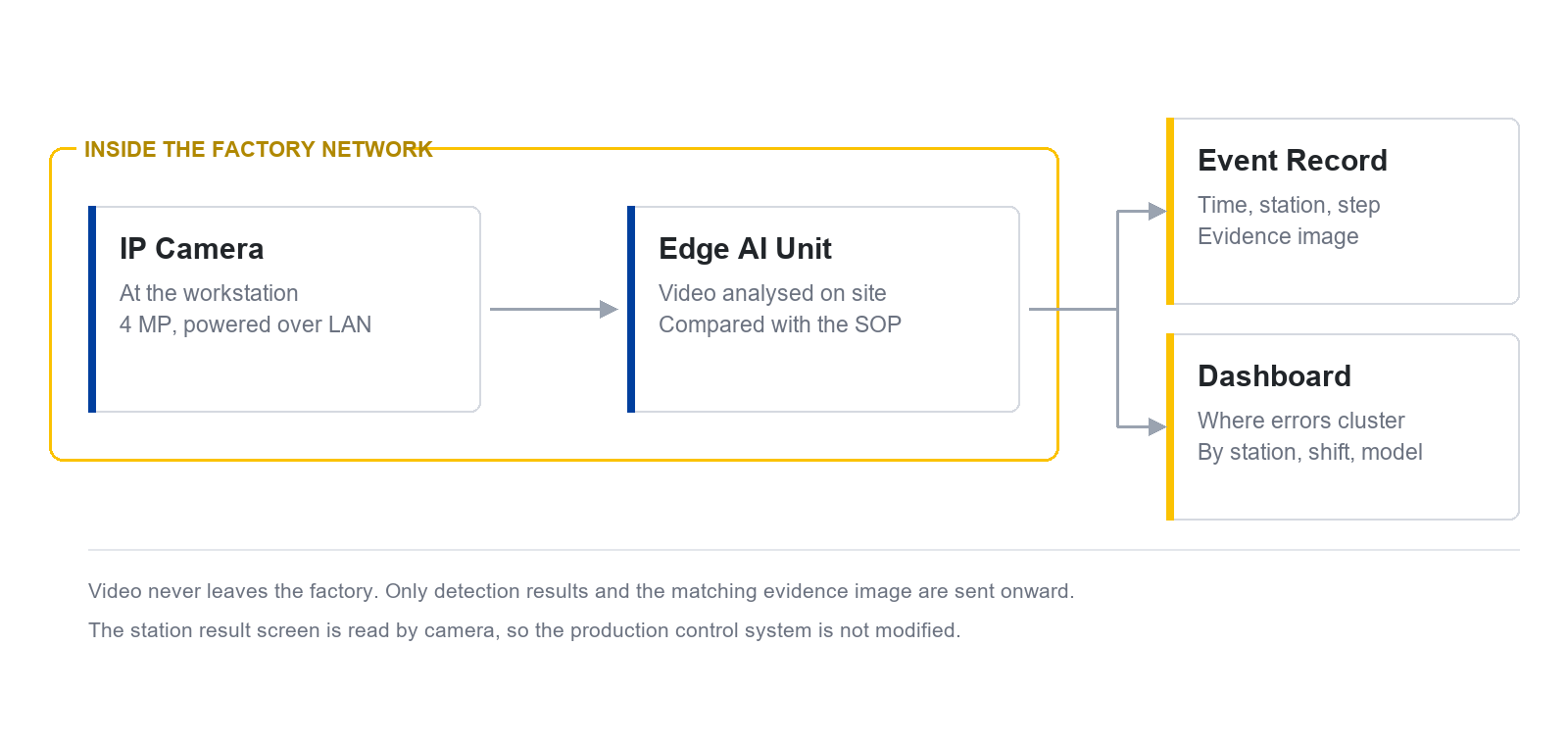
The point worth noting is the reading of the station result screen. The system reads that result with a camera rather than connecting into the production control system. This means it can be installed without modifying the factory's existing systems, and there is no risk of a new system affecting a production line that is already running.
Processing stays in the factory, footage does not go outside
The first question we always get is where the production line footage goes. The answer in the architecture the company uses is that all video analysis happens on a processing unit installed inside the factory, and footage is not sent outside for processing. What leaves the unit is the detection result and the evidence image for that specific event, nothing more.
That produces two kinds of output. The first is a list of events that departed from the standard procedure, with the time and an accompanying image, which can be reviewed afterwards to establish what actually happened in that second. The second is accumulated data showing which station, which shift, or which product model the errors cluster around, which is information you can genuinely act on to improve the process, unlike simply knowing that scrap occurred.
What has to be accepted before starting
A system like this does not work in every site condition. The requirement is that the camera can clearly see the activity in each step. If a step is obscured by the operator's own body, by equipment, or by the only camera angle that is physically achievable in that space, the system cannot check that step. The remedy is to adjust the camera position, or to adjust the layout slightly so it becomes visible, which is something to agree together after a real site survey, not something answerable from a floor plan.
The other thing to state plainly is accuracy. Image analysis is not always right. The criterion the company uses as its trial target is sequence checking accuracy of 90 percent or better, which means a portion still has to be reviewed by a person. The system therefore has to be designed so that people and the system work together, not so that the system decides everything in a person's place.
Why it should start as a small trial
The real risk in this kind of work is not that the technology cannot do it. It is that conditions differ enormously between factories: the lighting, the mounting distances, the actual work sequence which may not match the documented one, and working habits that vary from shift to shift. None of this can be assessed from documents.
The approach the company uses therefore starts with a trial of limited scope. Choose a small number of stations, mount everything temporarily without permanent cabling, then measure the accuracy against real production. The result tells you whether the camera positions are right, whether the checking conditions match the real work, and whether it is worth extending, before committing to a full investment.
In summary
AI video analytics does not replace the supervisor. It does the part that watching with your own eyes cannot manage, which is covering every station continuously and keeping evidence that can be checked. So the clearest benefit is not catching operators out. It is making problems visible at their source, instead of letting them surface as a complaint at the far end.
This article describes the approach the company has designed. It does not yet cite measurements from real use. Once results from a production line trial exist, we will publish them.
Checking how people work answers whether the procedure was followed, but it says nothing about how the machines themselves are running, which is the other half of the same question about what is happening on the floor. We covered that separately in the article on the IoT platform that turns machine data into something usable
Work of this kind sits within the company's End-to-End Solutions group. If you would like to discuss whether your production line suits this approach, please get in touch through our contact page