
If your factory is a designated factory under the Energy Conservation Promotion Act B.E. 2535 (1992), it already has a duty to manage energy and to report every year. A designated factory is one whose electrical capacity or energy use reaches thresholds set by law, as explained under the heading on what a designated factory already has to do under Thai law. When ISO 50001 comes up, whether from an energy inspector, a consultant or a business partner, the questions that follow are usually what the standard is, whether it differs from what the factory already does, and how much extra work it means.
This article covers three topics: the main requirements of ISO 50001, where Thai legal duties and the standard meet and differ, and the energy data that both of them depend on.
What ISO 50001 is
ISO 50001 is the international standard for energy management systems, published by the International Organization for Standardization, or ISO. An energy management system here means a set of interrelated elements that an organization uses to set an energy policy and objectives, together with the processes and procedures to achieve those objectives. English documents often shorten it to EnMS, for Energy Management System.
The current edition is ISO 50001:2018, updated in 2018, with an amendment, ISO 50001:2018/Amd 1:2024, titled Climate action changes, which covers climate change and was issued in 2024. The standard is voluntary and can be used by factories, commercial buildings and other kinds of organizations.
What sets ISO 50001 apart from a general target to cut the power bill is that the standard requires the organization to measure results against a reference set in advance, and to show that its energy performance has actually improved. It has four key parts.
- The energy review is the analysis of where energy is used and how much, in order to find the significant energy uses and the opportunities for improvement.
- The energy baseline is the amount of energy used in a reference period, used as the point of comparison to tell whether later results are better or worse.
- Energy performance indicators, or EnPIs, are the figures the organization chooses to track its results against the baseline.
- Objectives, targets and action plans state what the organization will improve, so that its energy performance keeps getting better.
What a designated factory already has to do under Thai law
The Royal Decree on Designated Factories B.E. 2540 (1997) makes a factory a designated factory when it is approved to use an electricity meter or to install transformers with a combined capacity of 1,000 kilowatts or 1,175 kilovolt-amperes or more, or when its combined use of electricity, heat and other non-renewable energy in the previous year is equivalent to 20 million megajoules of electrical energy or more. Several factories at the same address number are counted together.
The Ministerial Regulation on energy management standards, criteria and procedures in designated factories and buildings B.E. 2552 (2009), issued under the Energy Conservation Promotion Act B.E. 2535 (1992) as amended in B.E. 2550 (2007), requires the owner of a designated factory to do the following.
- Assess the initial status of energy management when starting for the first time.
- Write an energy conservation policy, have it signed by the factory owner, and announce it to staff.
- Appoint an energy management working group.
- Assess the significant uses of energy to evaluate the efficiency of energy conservation.
- Set energy conservation targets and plans, either as a percentage reduction from previous use or as an energy level per unit of production, with time frames, investment and expected results, and arrange training and activities for staff.
- Carry out the plans, then check and analyse the results against the targets and plans.
- Monitor, assess, review and correct deficiencies in energy management, at least once a year.
- Have the energy management inspected and certified by an inspector authorised under the law, then submit the report for the previous year to the Director-General of the Department of Alternative Energy Development and Efficiency, by the end of March every year.
Another ministerial regulation issued the same year requires the owner of a designated factory to appoint an energy manager within 180 days of becoming a designated factory. The energy manager's duty includes helping the owner manage energy under the regulation above.
How the law and ISO 50001 compare
Placed side by side, the two share much the same outline. Both start from a policy, both have targets and plans, and both check and review results. The differences are in who must do it, who checks it, and what comes out of it.
| Topic | Energy management under the law | ISO 50001 |
|---|---|---|
| Who must do it | Designated factories and designated buildings | Organizations that choose to, voluntarily |
| Who checks it | An inspector authorised under the law | An external certification body |
| What comes out of it | An annual report to the Department of Alternative Energy Development and Efficiency | A certificate from the certification body |
| How results are measured | A target as a percentage reduction, or an energy level per unit of production | Energy performance indicators against the energy baseline |
One point to note is that this ministerial regulation does not mention ISO 50001, and no clause exempts a certified factory from its duties. In the same way, meeting every legal duty does not lead to a certificate automatically, because a certificate requires an audit by a certification body. A factory that wants both should set things up so that both use one set of data and documents, and should ask the Department of Alternative Energy Development and Efficiency when it is unsure of its duties.
Every step starts with energy data
Whether the work follows the law or the standard, most of it depends on the same data: how much energy each area uses in each period. An electricity bill shows only total use for the billing cycle, so it cannot tell which part of the factory uses the most energy, and that is the first question for both the legal assessment of significant energy use and the energy review under the standard.
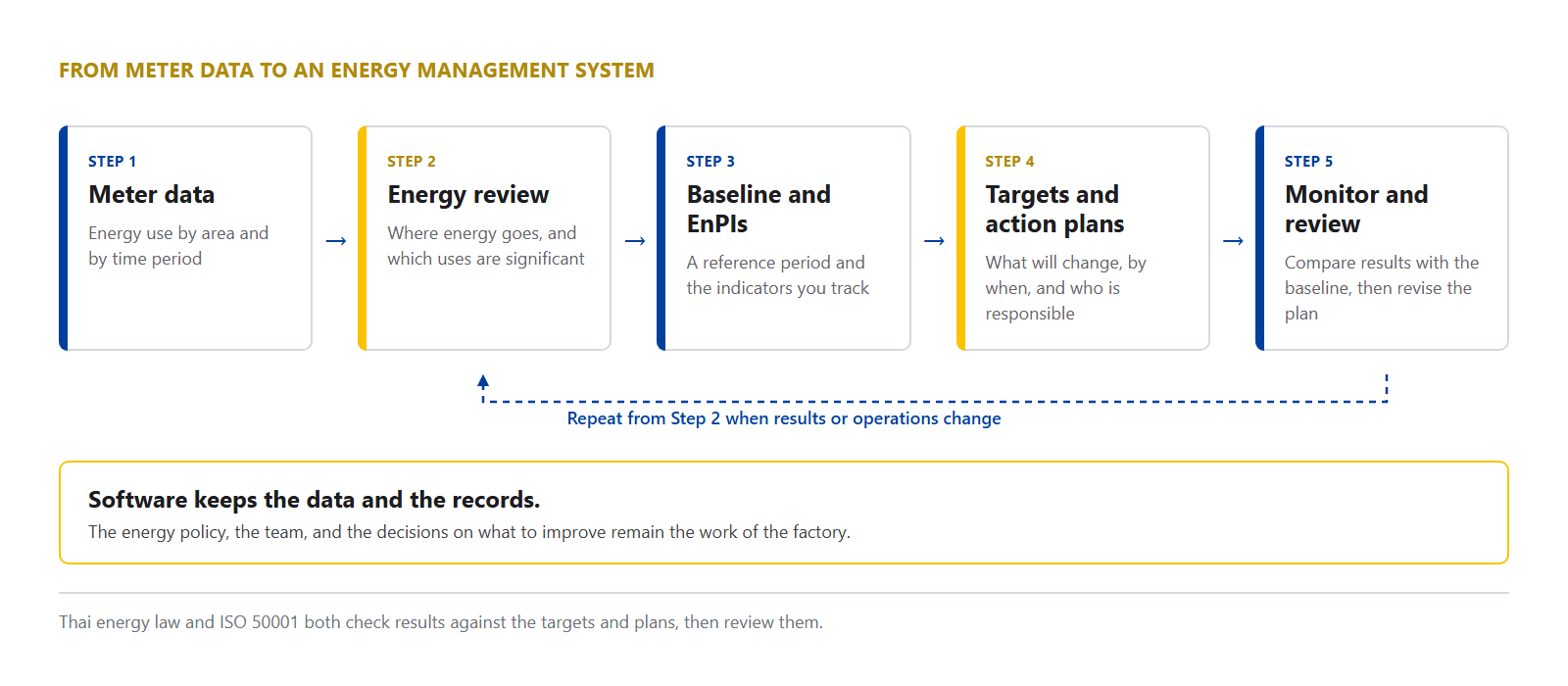
The diagram shows the order in which the data is used. Steps one to three need data that is collected continuously and can be compared. Steps four and five need a record of which plans were carried out, what they cost and what they achieved. Software helps with collecting the data and keeping the records, while the decisions remain the work of people in the factory.
Energy Monitoring from DigitechX tracks the electricity use of production lines and utilities, with meter readings, historical trends and reports to identify points that need investigation, which matches the work in steps one and two.
The Energy Management System (EMS) links electricity use with targets, energy-saving plans, budgets and responsibilities, so each project's results are tracked from the same records, which matches the work in steps four and five.
Before using meter readings to set a baseline, check which area and equipment each meter covers, and whether the time periods and units of the data match. How to check these points is explained in the article Checking electricity use with meter data
What the standard and software cannot do
If we described only the parts that software helps with, this article would be incomplete, so here are three limits, stated plainly.
Software does not get a factory certified. An ISO 50001 certificate is issued by an external certification body after it audits the factory, not by ISO and not by DigitechX. Our systems help keep the data and records ready for the day of the audit.
Incomplete data puts the baseline wrong from the start. If the meters do not cover the areas that use the most energy, the system can only show what is measured. Before starting, check whether the existing measurement points cover most of the factory's energy use.
The policy, the team and the decisions remain the factory's work. Both the law and the standard have requirements for an energy policy, people with responsibility, and the review of results, and software cannot do these on the factory's behalf.
Closing
ISO 50001 and legal energy management can use the same data. A factory that collects complete and continuous energy data by area can carry out both from one data set. A factory that does not yet have such data should start by checking and adding measurement points before setting targets.
If you would like to discuss whether the data your factory already has is enough to begin, you can reach us on our contact page