
When customers ask for faster product changeovers, machine builders need to establish where time is spent: preparation, adjustment or first-piece approval. Overall equipment effectiveness (OEE) records identify stopped periods. Operators and engineers then add the task details needed to choose a practical improvement.

1. Agree when the clock starts and stops
Vorne explains that changeover measurement needs a consistent policy, such as the interval between the last good part of the old job and the first good part of the new job. Different definitions produce misleading comparisons.
Match the changeover pair
Compare the same product-to-product transition under similar material and staffing conditions, rather than grouping every setup together.
Record the waiting reason
Separate parts preparation, adjustment, cleaning and first-piece approval. One generic changeover code conceals which stage needs attention.
Sources: [1]
2. Investigate machine-related tasks
Changeovers during planned production are an availability loss in OEE. Recorded time still requires engineering review before deciding which tasks can safely be shortened.
Review preparation work
Assess whether parts, tools or approved settings can be prepared before stopping. Never remove energy-isolation or safety-verification steps to improve the time.
Address one cause
If the delay concerns missing parts, improve preparation before redesigning the mechanism. Trial one measure and record any unintended effects.
Sources: [2]
3. Check recovered time and quality together
Reaching the first part sooner may create more rejects immediately afterwards. Review setup time, good output and startup rejects together before presenting the result to the customer.
Use several repetitions
Include ordinary and difficult runs. Compare the typical duration and range rather than selecting only the fastest result.
Illustrative calculation
Saving eight minutes across ten comparable changeovers recovers 80 minutes. That time only becomes extra output when demand and downstream capacity allow it.
Frequently asked questions
How does this relate to SMED?
SMED is an approach to reducing changeover time. Records help select tasks for study, while qualified people still need to assess and redesign the work.
Is a simple stopped signal enough?
It identifies time, but suitable machine signals or operator input are needed to distinguish the changeover reasons.
Measure changeovers for one machine model
Explore DigitechX OEE with the current changeover procedure and machine signals to define the events and reasons worth recording.
Click to view details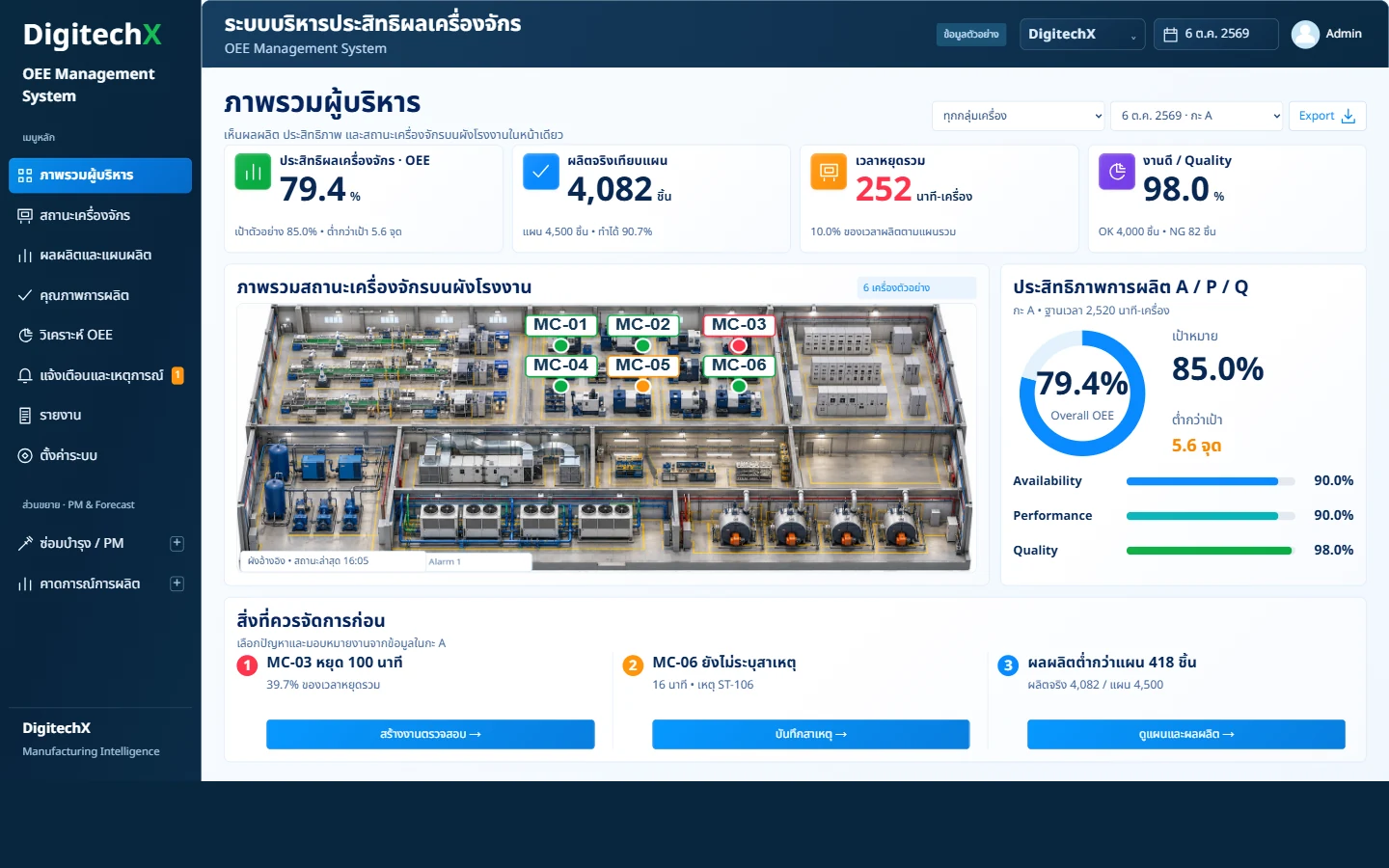
References
Information and sources reviewed: 9 October 2026